


Embodiment vs. Performance: What It Really Means to Become Someone

Updated: Feb 25

"Fake it till you make it" is the number one phrase that makes me gag. Honestly, if I were good at pretending to be someone else, I would've made a career out of it by now.
This is why I respect actors and actresses to some extent, mainly referring to the ones who act in a variety of movies and somehow avoid being typecast. The ability to be so mutable that you can portray the characteristics of someone you are inherently not is truly impressive.
While actors step into different roles on screen, acting is part of our everyday lives off the screen. Many people will act holier than thou and call themselves a real one, but to some extent, humanity pretends in one way or another. People act differently at home vs school or work and with friends vs. family. Sometimes on an emotional level, we pretend to be okay when we are not because we are trying to be considerate of others, or not be considered a downer, or that we are ruining the vibe.
Many of us feel pressured to perform different versions of ourselves in real life. The desire to be liked isn't necessarily about worth once you're out of the school system. It's about opportunities. In many cases, it's a method of survival and wanting to have a sense of security.
Some people can perform these traits well enough to get by in the world. But for the rest of us, performing isn't a sustainable method. We have to embody and become.
You're probably asking: what does that even mean? From my perspective, embodiment is an art that involves evolving through your actions. You aren't just "acting" like the person you want to become. You're doing tangible things to become that person. It's not just changing the way you speak or the outside things like your style. It's more about the habits, skills, and what you do on a day-to-day basis.
I just finished recording the last episode of my February 2026 series about late blooming and am preparing for the March episodes about something that has also been heavy on my mind: adulthood or, from my lens, womanhood. These thoughts perfectly align with what I'll be talking about in this post, which is inspired by episode 63 of A Little Atypical.
Before you continue reading, I highly recommend checking out the full episode to get the complete context and depth of this conversation.
Episode No. 63
Where to listen:
Quick Summary
Who This Post Is For: Deep feelers, unconventional thinkers, neurodivergent individuals, and anyone who's ever felt exhausted by the "fake it till you make it" advice. If you value authenticity and struggle with maintaining facades, this is for you.
What You'll Learn: The critical difference between performing a role (exhausting and unsustainable) versus embodying transformation (evolving through aligned actions). This post explores why constant performance deepens imposter syndrome, how to recognize traits you already possess, and practical frameworks for assessing whether you're performing or truly becoming in different areas of your life.
Key Insight: You don't need to pretend to be someone you're not. You already have foundational traits that align with who you want to become. You just need to recognize and nurture them through tangible habits, skills, and daily practices that honor your authentic self.
The original episode challenges the popular "fake it until you make it" advice and explores why constantly performing confidence can actually deepen feelings of disconnection and imposter syndrome. In this episode, I revealed how many of us already possess the foundational traits we need to become who we're working toward. We just need to learn to recognize and nurture them instead of creating an exhausting persona.
Something I prioritize as a creator is making content centered around ideas we can always come back to and build on instead of worrying about hopping on trends. I'm very intentional with how I create because I want every body of work I produce to be around longevity, offering practical ways to build genuine confidence by honoring who you actually are while intentionally growing into who you want to become. So, for today, I wanted to go a step further than what I published to talk about the reality of becoming (at least from my experience so far).
What Becoming Actually Looks Like
So what does it really mean to become? After spending months reflecting on this, here's what I've learned through my own experience:
Shifting Perspectives and Sitting with Being Wrong
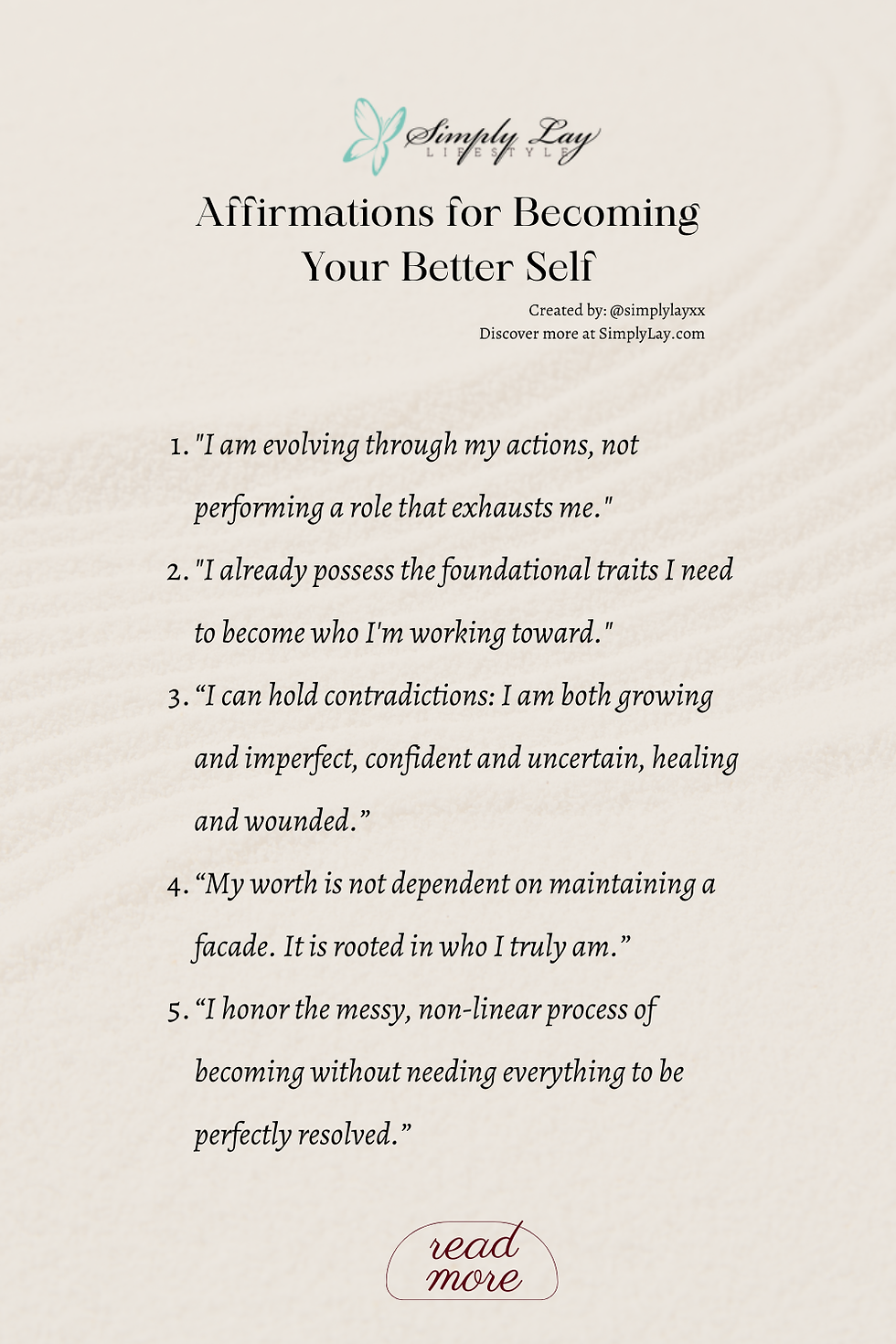
Becoming requires the ability to shift perspectives, and not just once, but continuously. A huge part of becoming is accepting the moments you were guided by ego, guided by your outside thoughts, guided by desire, and in some of those cases, you were wrong. The challenge is being able to sit with being wrong or not handling things as well as you should have, without it eating you alive. It's about sitting in the discomfort of realizing that a version of yourself that once felt so certain was actually operating from a place of fear, insecurity, or misunderstanding.
This doesn't mean you were a bad person or that your past self was fundamentally flawed. It means you were human. You were doing the best you could with the awareness you had at the time. And now, with a new perspective, you can see where you fell short, not to punish yourself, but to learn and grow from it.
I think a huge part of it is accepting multitudes and that many things can be true at once. You can be growing and still make mistakes. You can become someone new while honoring who you were. You can hold contradictions without letting them paralyze you. You can be both confident and uncertain. You can be healing and still have wounds. You can love someone and still choose to walk away. You can grieve a past version of yourself while celebrating the person you're becoming.
The ability to hold these contradictions is what makes becoming possible. Because if you need everything to be perfectly resolved, perfectly consistent, perfectly aligned at all times, you'll never allow yourself the space to evolve. You'll stay stuck in performance mode, maintaining a version of yourself that feels safe and predictable rather than stepping into the messy, complex, ever-changing reality of who you actually are.
Examining Your Values: What You Want vs. What You Think You Should Want
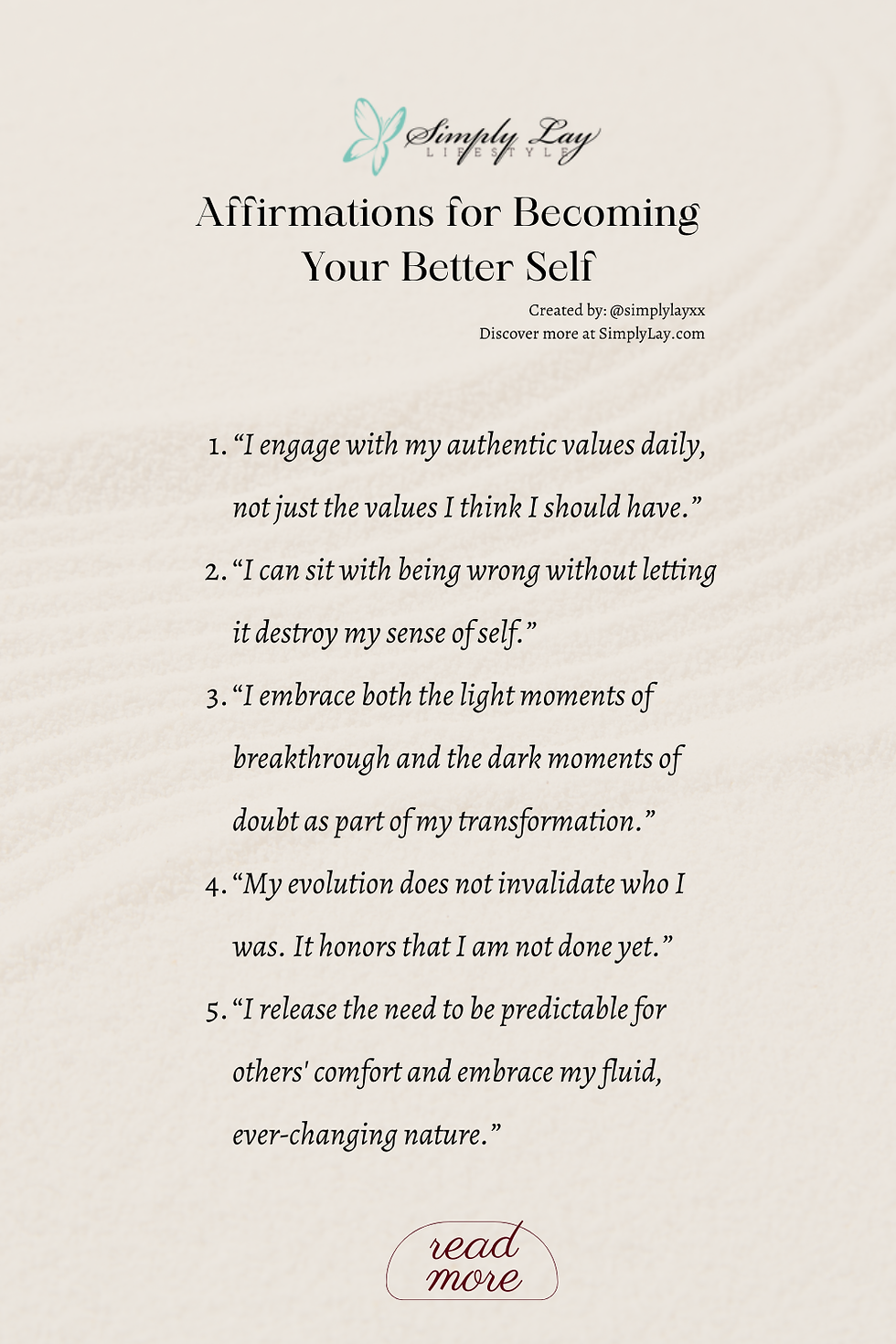
Once you've accepted that growth means embracing contradictions, the next step is examining what actually matters to you. Becoming is also about looking at your values to know: are they what you want or just something you think you should want? In book club, a person suggested creating sub-values, which I found very interesting. While I haven't tried it for myself yet, I can say it might be something worth trying.
I have listed my values before, but I think the best way to know if something is truly your value is how much you actually engage with it. For example, my biggest value is creativity, and I am currently still doing my Fruits Basket rewatch. One scene that hit harder this time around was when Yuki Sohma and Tohru Honda visited Ayame Sohma's shop. It was right after they got told to think about the future for the parent-teacher conference, and Yuki admits it's hard for him to picture.
Honestly, one thing I am learning as an adult is that sometimes your vision of what life is supposed to be like changes. I barely knew at 16 and was hit hard with the reality that I had to choose something. Once I was in college and was experiencing the things I thought I wanted, it changed me.
However, watching that conversation between Yuki and Ayame, when Ayame said, "I just wanted to make sure that I had the power to make something. Maybe I wanted to know if I could create something with my own hands. If there could be something that couldn't exist without me," that was the scene that made me think so heavily about the balance of give and take in the world.
It's crazy because this is my 3rd or 4th time watching it, but I love to do so because it's one of those shows that if you rewatch enough, you'll pick up something new every single time. He put into words why creation is so important to me, how it feels like a sense of power especially when you are in a place of feeling like there is a lack of freedom. But also how creation, as much as it is a self-fulfilling process and expression, is also a way to give to the world.
I also realized how much I see creation in everyday life, from writing and podcasting to the mundane act of cooking.
Taking the Dark and Light in Strides

Understanding your values is crucial, but becoming also requires accepting that the journey isn't always comfortable. In fact, becoming means taking the dark and light in strides. There are moments where you have light: when you get the result you want, when you notice the small wins leading up to it, the consistency, the things that were once hard becoming regular for you, and there is no longer resistance.
But between those moments of light are also dark moments: the feelings of doubt, wanting to quit or give up entirely, feeling frustrated, wondering when things will get better for you or if they ever will.
Becoming is not a linear process. Sometimes it is going through a grieving process of the timeline you had in your head, the identity that no longer exists, and not to mention all the shifts external to you. I'm not saying it's all bad, but there are a lot of emotions that come with the process even while you're evolving through the actions.
Sometimes it may feel that there is more than one of you, especially in a phase when you are just in the process of changing. But at the end of it all, there is also satisfaction in the sense that I did the thing and kept showing up despite wanting to quit.
You don't know how many times I have said I want to quit school while I was in college, or that I want to give up on creating because it is too time-consuming, or that I want to completely give up on love. I say those things or maybe just think them, but I do the actions anyway because on a soul level, giving up has never been something that would actually happen.
It takes so much out of me to give up, and even when I make the choice to let someone or something go, it does linger a bit. I think what happens is the actions are typically the first things to change, then you have to put in effort to change your mind to keep doing those things. However, if it's something your soul wants more than anything, I think it's slightly easier to keep going while your mind is catching up. Then your entire reality changes because your perception changes.
It's kind of what I was alluding to with watching Fruits Basket. I get something different out of it every time because what information I zoom in on or what sticks out to me is based on what I'm experiencing. This constant evolution of perception is at the heart of what it means to become rather than simply perform.
The Fragility of Performance and the Strength of Becoming
I don't think performance is necessarily bad, just unsustainable. Honesty is another one of my core values, so in the past, it always frustrated me when I saw how easily people could lie and perform. It never made sense to me; there was always some disconnect I couldn't bridge.
However, as I got older, I started to understand it a little bit more. I see it now as presenting layers of yourself as opposed to fully lying. I think on some level, not everyone deserves to see the full version of us. And I also don't think there's a limit to self-discovery. We will constantly change, and that will make some people uncomfortable because we like predictability.
If someone is so fluid and ever-changing, it's like a reminder to people that they were wrong. In a sense, they had an idea about you, and you actively changed, proving that idea incorrect. And sometimes people don't like to believe they could change either. Maybe that's why some people are so comfortable with performance over being.
A person can technically become through performance, but what happens when that act in your life ends? When someone who centers their identity around their career is fired or retiring? Or if so much of your identity revolves around being a parent and you no longer have kids to raise? Maybe this is why identity crises exist: when we tie these labels to our purpose as if we should only have one.
I guess that is my biggest grievance with performance: how fragile it makes me feel and how it disrupts the confidence I'm trying to build. When you're performing, your sense of self is dependent on maintaining that facade. But when you're becoming, your confidence is rooted in the truth of who you are and who you're actively growing into.
Becoming allows for the multitudes. It allows for change without the collapse. It honors that you can be many things, that you can evolve, and that evolution doesn't invalidate who you were. It just means you're not done yet.
Reflection Prompts: Assessing Performance vs. Embodiment
To help you assess where you might be performing versus embodying in your life, here are some reflection prompts to sit with:
Do you think identity has a bigger impact on relationships, or that relationships have a bigger impact on identity? Reflect on how the people around you shape who you are versus how your sense of self influences the connections you form. Where do you see yourself performing to maintain relationships, and where do you feel you can be yourself fully?
What are the signals that you're performing rather than embodying? Notice the moments when you feel exhausted, disconnected, or like you're "putting on a show." When a major role in your life ends (whether through job loss, retirement, an empty nest, or a relationship ending), how do you respond? Do you experience an identity crisis, or do you find parts of yourself that exist beyond that role? What would your "next act" look like if it wasn't built on performance, but on who you actually are?
In what areas of your life do you feel the dark and light of becoming most intensely? Where are you experiencing both growth and grief? What are you letting go of, and what are you stepping into? How do you honor both the difficulty and the progress?
Think of a moment when you outgrew a version of yourself that others still needed you to be. What did you protect by staying small, and what did you risk by expanding anyway? Explore the tension between honoring your own evolution and preserving others' comfort. Did you choose their version of you or your own? What would it mean to fully release the need to be who you used to be for the sake of others' stability?
The human experience is a mosaic. What pieces do you fixate on in the process of becoming? Consider whether you focus most on relationships, titles, metrics, achievements, or external validation. How do these pieces influence whether you're performing or truly becoming? What would it look like to engage with these aspects of your life in a way that supports authentic transformation rather than maintaining a facade? Which pieces would you need to release, and which would you need to integrate more deeply into your sense of self?
Key Takeaways
Embodiment over performance: True confidence comes from evolving through your actions, not pretending to be someone you're not. Embodiment involves tangible habits, skills, and daily practices that align with who you're becoming.
You already have what you need: Instead of creating an exhausting persona from scratch, recognize and nurture the foundational traits you already possess that align with your goals.
Becoming requires holding contradictions: You can be growing and still make mistakes. You can be confident and uncertain. Accepting multitudes allows you to evolve without needing everything to be perfectly resolved.
Examine your values authentically: Distinguish between what you genuinely want and what you think you should want. Your true values show up in how much you actually engage with them, not just in how they look on paper.
Becoming is non-linear: Expect both light moments (wins, consistency, breakthroughs) and dark moments (doubt, frustration, wanting to quit). The process involves grieving old timelines and identities while celebrating growth.
Performance is fragile; becoming is sustainable: When you're performing, your sense of self depends on maintaining a facade. When you're becoming, your confidence is rooted in the truth of who you are and who you're actively growing into.
Listen to the full episode: For deep feelers and unconventional thinkers who want to approach beauty, wellness, and personal development beyond the surface, follow A Little Atypical podcast. As the "It girl with an IQ," I wholeheartedly believe in moving past superficial advice to explore what truly supports authentic transformation.
Episode 63 Description:
Ready to ditch the exhausting performance? 🎭 In this game-changing episode, we're exposing why "fake it until you make it" might be the very thing holding you back from real growth. If you've ever felt disconnected, drained, or like a fraud while trying to level up, this is the wake-up call you need.
Join me as I share my personal journey of attending a conference where the pressure to perform nearly broke me and the powerful realization that changed everything. Discover why embodying your authentic traits is infinitely more powerful than faking confidence you don't feel.
✨ What You'll Learn:
Why "fake it until you make it" creates disconnection instead of confidence
The crucial difference between performing and embodying your growth
How your "negative" traits are actually hidden superpowers waiting to be channeled
Real strategies to show up authentically while actively becoming who you want to be
🔥 Perfect for you if:
You're tired of feeling like an imposter in your own life
You've been forcing yourself to "act confident" but feel more anxious than ever
You're ready to build real, lasting confidence from the inside out
You want to embrace your authentic self while still pursuing ambitious goals
You're navigating a personal rebrand or major life transition
This is the final episode in our micro rebrand series; catch episodes 60 and 62 for the complete journey from people-pleasing to authentic confidence!
💭 Today's Reflection: What if the traits you've been trying to hide are exactly what you need to embrace to reach your goals?
ABCs of Adulting Blogs
Follow my socials
Tik Tok- @Simplylayxx
YouTube- @SimplyLayxx
Instagram- @Simplylayxx
Twitter- @Simplylayxx
Pinterest- @Simplylayxx
Check out my blog post www.SimplyLay.com
Music by Remil - Evening Tea - https://thmatc.co/?l=DFECB5D4
Section | Timestamp | Notes |
Questioning "Fake It Until You Make It" | 00:00 |
|
Why "Fake It Until You Make It" Doesn't Work for Everyone | 01:44 |
|
The Persona Trap: When Performance Becomes Protection | 05:54 |
|
Recognizing the Seeds: How Your Existing Traits Already Reflect Who You're Becoming | 12:34 |
|
From Performance to Practice: Embodying Who You're Becoming | 17:57 |
|
Wrapping Up: Gratitude, Card Readings & What's Next | 22:17 |
|
FAQ
What's the difference between embodiment and performance?
Performance is maintaining a facade or acting like the person you want to be, which is exhausting and unsustainable. Embodiment is evolving through your actions by doing tangible things to become that person through habits, skills, and daily practices that align with your authentic self.
Why doesn't "fake it till you make it" work for everyone?
For many people, constantly performing confidence deepens feelings of disconnection and imposter syndrome. Performance creates a fragile sense of self that collapses when you can no longer maintain the act. It's particularly unsustainable for those who value authenticity and struggle with pretending to be someone they're not.
How do I know if I'm performing or embodying?
Signs of performance include feeling exhausted, disconnected, or like you're "putting on a show." You might experience identity crises when major roles end. Embodiment feels aligned with your core values and allows you to hold contradictions without paralysis. You can be uncertain while confident, healing while wounded.
What does it mean to "hold contradictions" in the process of becoming?
Holding contradictions means accepting that many things can be true at once. You can be growing and still make mistakes. You can grieve a past version of yourself while celebrating who you're becoming. You can love someone and still choose to walk away. This ability prevents you from staying stuck in performance mode, where everything must be perfectly consistent.
How do I distinguish between my authentic values and values I think I should have?
The best indicator of a true value is how much you actually engage with it, not just how good it sounds. Your authentic values show up in your daily actions and choices. If you claim creativity is important but never create anything, it might be an aspirational value rather than a core one.
Is" becoming" always a positive experience?
No, becoming is not linear and involves both light and dark moments. You'll experience wins, breakthroughs, and things becoming easier, but also doubt, frustration, grief over old timelines, and the urge to quit. The key is continuing the actions even when your mind hasn't caught up, trusting that your perception will eventually shift.
What happens when performance-based identity collapses?
When you tie your identity to specific roles (career, parenthood, relationships) and those roles end, you may experience an identity crisis. This is why performance is fragile: it depends on external circumstances. Becoming builds confidence rooted in who you actually are, allowing for change without complete collapse.
Can you become through performance?
Technically, yes, but the question is: what happens when that act ends? Performance-based becoming leaves you vulnerable to identity crises when circumstances change. Authentic becoming honors your multitudes and allows evolution without invalidating who you were. It recognizes you're not done yet.
Why do people make me uncomfortable when I change?
People like predictability. When you're fluid and ever-changing, it reminds others they were wrong about you. They had an idea, and you proved it incorrect. It also challenges their belief that they can't change. Your evolution can be uncomfortable for those who prefer static identities.
Where can I explore these ideas further?
Listen to episode 63 of A Little Atypical for the complete conversation that inspired this post. The podcast is designed for deep feelers and unconventional thinkers who want to approach personal development, wellness, and lifestyle topics with depth and authenticity. It moves beyond surface-level advice to explore what truly supports transformation.

About the It Girl with an IQ
I'm Lay, a writer, podcast host, YouTuber, and lifestyle content creator exploring the intersection of beauty, wellness, and personal development with intellectual depth. Through A Little Atypical, I create content for deep feelers and unconventional thinkers who want substance beyond surface-level advice. I believe you don't have to choose between being glamorous and being thoughtful. You can embody both.


Comments